

A standard photo size is 4 x 6. This is the most commonly printed photo in the world and is equivalent to the 3:2 aspect ratio that is the default from most digital cameras and smartphones. However, “standard” does not necessarily mean “the only option.”
Whatever type of print you are making, whether it be a wallet photo, a frame around a portrait, or a part of a gallery wall, determines which of these sizes will work best for you, and choosing the wrong size can cause a cropping or blurring problem with your prints.
Quick Answer:
Normal photo print size = 4 x 6 (10 x 15 cm), and other popular photo sizes are 5 x 7, 8 x 10, and 11 x 14. The correct photo size will depend upon your photo’s aspect ratio, where you plan to display your photos, and the number of pixels in your original images. Typically, when creating prints, you should shoot at a minimum of 300 PPI for a clear print.
What Is the Standard Size of a Photo?
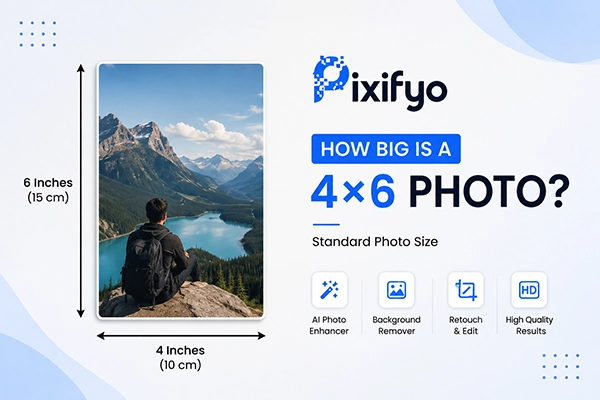
A “Standard” Photo Size (or simply “Photo Print”) are the most popular sizes for photo printing at many labs, in photo books, picture frames, and other items. The 4 x 6 inch format has been the standard for decades, as it fits well within the typical 3:2 (3 units wide, 2 units tall), which was the common ratio of most 35 mm film cameras.
Today’s cameras and smartphones also have a similar ratio. Therefore, when you import photos from your smartphone or camera directly into a photo printing app, 4×6 is typically what you get if you don’t adjust the size.
Pixifyo Tip:
Before ordering a large quantity of prints, make sure you know your smartphone’s camera default aspect ratio. Many smartphones have an aspect ratio of 4:3, and some photography apps produce a 3:2 ratio by default. Knowing which you are working with before printing can help avoid unintended cropping in your photo.
Common Photo Sizes and Their Aspect Ratios
Most common photo formats are part of only four families of aspect ratios (i.e., 3:2, 4:3, 5:4, and 1:1), and nearly all standard prints have roots in at least one of these. Below is the list of the ten most commonly ordered photo formats, including their corresponding required minimum pixels to produce a high-quality 300 PPI print.
| Print Size | Metric Equivalent | Aspect Ratio | Recommended Pixels (300 PPI) | Common Use |
| 4 x 6 in | 10 x 15 cm | 3:2 | 1200 x 1800 px | Everyday snapshots, albums |
| 5 x 7 in | 13 x 18 cm | 7:5 | 1500 x 2100 px | Greeting cards, small frames |
| 8 x 10 in | 20 x 25 cm | 5:4 | 2400 x 3000 px | Framed portraits, wall display |
| 11 x 14 in | 28 x 36 cm | 11:14 | 3300 x 4200 px | Larger framed prints |
| 12 x 18 in | 30 x 45 cm | 3:2 | 3600 x 5400 px | Wall art, statement pieces |
| 16 x 20 in | 40 x 51 cm | 4:5 | 4800 x 6000 px | Gallery walls, canvas prints |
| 20 x 30 in | 51 x 76 cm | 2:3 | 6000 x 9000 px | Posters, large wall art |
| 4 x 4 in / 5 x 5 in | 10 x 10 / 13 x 13 cm | 1:1 | 1200 x 1200 / 1500 x 1500 px | Social media crops, modern square displays |
Pixifyo Tip:
If your photo doesn’t match a standard aspect ratio exactly, most labs will crop it automatically to fit. Before you order, crop the image yourself in an editor so you control exactly what gets cut off, especially with portraits, where an automatic crop can easily clip a chin or the top of someone’s head.
What Is a Normal Picture Size for Everyday Prints?
The typical picture sizes for everyday prints, family photos, vacation pictures, or images to be placed inside an average album are four-by-six (4×6) inches and five-by-seven (5×7) inches. Both sizes account for the large majority of personal photo printing due to their affordability, availability at all photo labs, and compatibility with virtually any photo album/frame available from a retail outlet.
The next level up, if you’re printing something specific, a framed portrait, a gift print, or wall art, would be eight-by-ten (8×10) and eleven-by-fourteen (11×14). They will provide a larger visual impact than the previous sizes while still remaining within the realm of standard size prints that do not fall into what could be called a statement piece.
Standard Photo Developing Sizes by Photo Lab
Photo developing sizes are generally standardized among labs, but some offer “Plus” or “Super” versions that better match ratios closer to 3:2 rather than cropping. You usually see two versions of a size, such as:
- Standard (nR): Long side is the short side plus 2 inches for sizes less than 11 inches or plus 3 inches for sizes 11 inches and up; for example a standard 5R is 5 by 7 inches.
- Super or Plus (SnR/nR plus): Designed to keep as close as possible to the true 3:2 ratio and minimize loss from photos shot on full-frame cameras and phones.
This distinction becomes important once you print at 8 inches or larger because differences between a standard crop of 5:4 and the true 3:2 ratio become noticeable, especially for portraits or photos where subjects are near edges.
Photographic Sizes for International and Passport Photos
Photographic sizes go beyond wall prints. Passport photos, ID photos, and international formats have their own separate standards. Here are a few examples:
US passport photo: 2 inches by 2 inches (51 mm by 51 mm)
UK and EU passport and biometric photos: 35 mm by 45 mm
Standard wallet photo: 2.5 inches by 3.5 inches
Metric sizes (ISO 1008) are common in parts of Europe and Asia and measured in millimeters (for example, 9 cm by 13 cm, 10 cm by 15 cm, and 13 cm by 18 cm). Always double-check sizes in millimeters if printing for an international audience or filling out government forms because standard sizes based on inches don’t translate perfectly.
How to Choose the Right Standard Photo Print Size
Determining the correct photo printing size is based upon 3 things: Your photo’s original aspect ratio, the final image resolution of the photo, and where the printed version of the photo will be placed.
- First, check the resolution of your image: In order to get a high-quality image, you want to have around 300 pixels/inch in your photo. If you are using a lower pixel count in your photo, such as 800 x 1200, then no matter what calculations say, your photo will still appear blurry when it is enlarged to an 8×10.
- Secondly, match the aspect ratio prior to cropping: The aspect ratio of your original photo (normally 4:3 or 3:2) should be compared to the target size you desire to print your picture. Crop your images instead of allowing the lab to do this automatically.
- Thirdly, think about where the printed version of your photo is going: Images intended for wallets or albums tend to stay small (4×6 or less). Gift prints work best at sizes like 5×7 or 8×10. Wall art generally begins at sizes like 11×14 and can go larger from there.
Pixifyo Tip:
Struggling with a photo that looks great on screen but grainy or oddly lit once you try to print it larger? Our guides on how to fix grainy photos and how to fix overexposed photos walk through the most common fixes before you send anything to print.
Standard Photo Sizes vs. Poster and Banner Sizes
For regular framed photos, most standard photo sizes are no longer than about 20 x 30 inches, at which point they move into what we call poster and banner categories.
Poster sizes and banner sizes have their own set of rules for size, as do other formats (i.e., signs) that are designed to be viewed from afar rather than to maintain an exact ratio of aspect. If your work will require large-format printing (think: large banners/signs, large wall prints, etc.), it’s worth noting that the sizing rules for this type of printing will differ somewhat from those used when printing smaller photos.
We’ve created specific guides to help explain how to choose the right size poster or banner for your needs.
Conclusion
Knowing standard photo sizes removes uncertainty when printing, whether you are filling photo albums, framing portraits, or preparing files for a print shop. Start with the aspect ratio of your photo and match it to the closest standard size, and check resolution before you print.
Need help getting photos ready first for printing? We offer photo editing services to clean up resolution, exposure, and cropping issues before ordering, and you can find more sizing guides on the blog at Pixifyo.
FAQs
Q1: What does a typical photograph look like?
A standard photograph measures four by six inches (10 cm x 15 cm). Most standard photographs measure with a three-to-two aspect ratio and are taken from most camera phones, including smartphone devices.
Q2: What are some standard sizes of photographs to frame?
The two most common framing sizes are five-by-seven, eight-by-ten, and eleven-by-fourteen. Eight-by-ten photos are particularly popular due to their widespread availability within pre-assembled frames.
Q3: How big should my image be for social media?
Most social media sites have square one-to-one crops (for example, 4 x 4, 5 x 5) which will appear as a square image when posted. This is because many social media sites default to this type of crop format.